MVP Development
How Much Does It Cost to Build an MVP in 2026?
A practical guide to MVP pricing, AI-assisted development, scope, timelines and the decisions that determine what you actually need to build.
September 2026 9 min read Aurimas @ Advansis LT
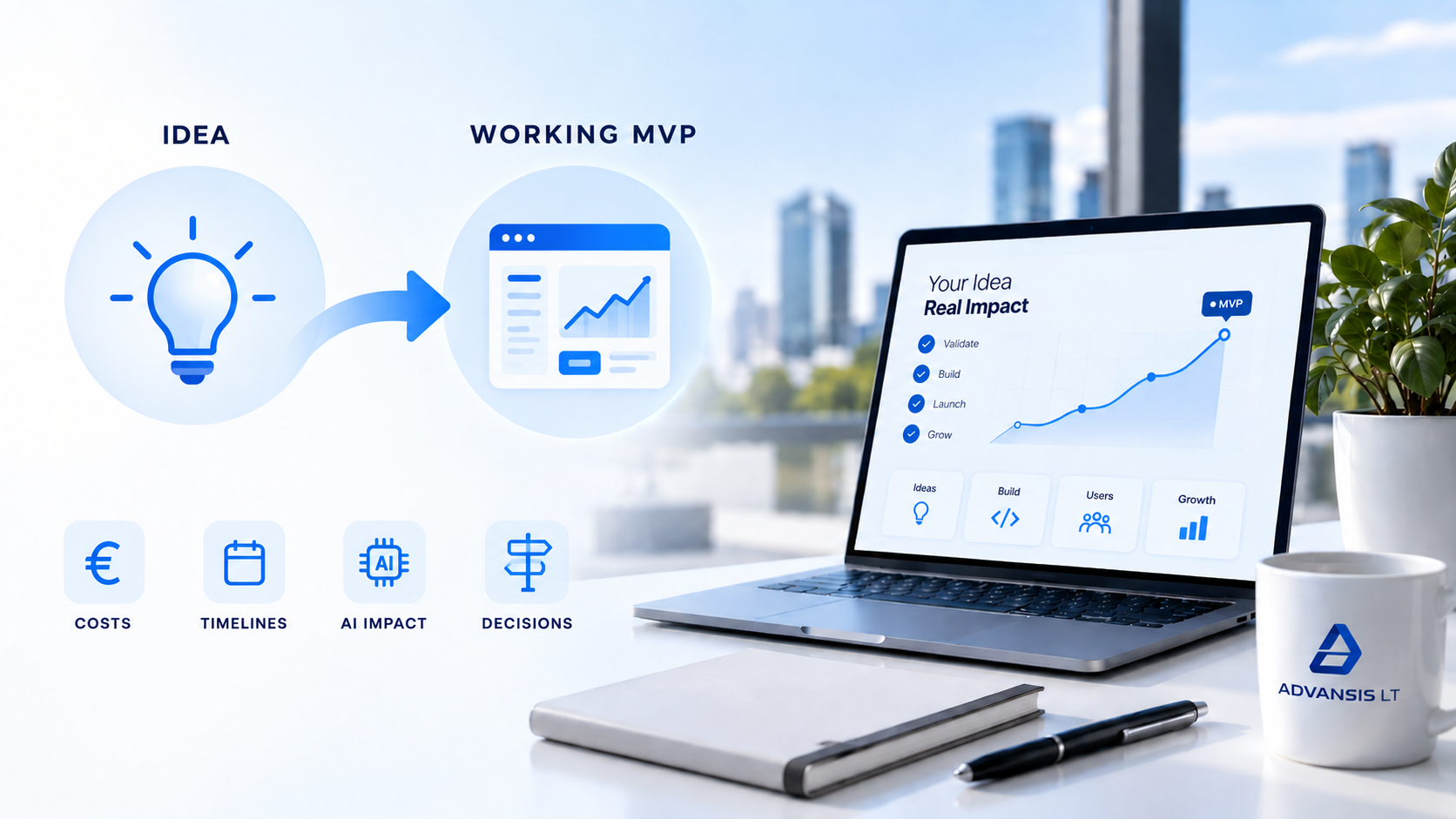
The cost of an MVP is not determined by the number of ideas behind it. It is determined by the smallest dependable product that can test the most important business assumption.
For European founders and businesses, that means balancing speed with enough product thinking, design and engineering quality to put the application in front of real users.
Typical MVP development costs in Europe
The ranges below are useful planning benchmarks rather than fixed quotations. The same product idea can sit in different bands depending on what must be proven in the first release.
| Product type | Typical investment | Best used for |
|---|---|---|
| Prototype | €5K–€10K | Testing a concept, journey or investor narrative |
| Lean MVP | €10K–€20K | Validating one core workflow with early users |
| SaaS MVP | €20K–€50K | Launching a sellable product with accounts and billing |
| Complex MVP | €50K–€150K+ | Multiple roles, integrations, AI and regulated workflows |
- Product type
- Prototype
- Typical investment
- €5K–€10K
- Best used for
- Testing a concept, journey or investor narrative
- Product type
- Lean MVP
- Typical investment
- €10K–€20K
- Best used for
- Validating one core workflow with early users
- Product type
- SaaS MVP
- Typical investment
- €20K–€50K
- Best used for
- Launching a sellable product with accounts and billing
- Product type
- Complex MVP
- Typical investment
- €50K–€150K+
- Best used for
- Multiple roles, integrations, AI and regulated workflows
MVP with Advansis LT
€3,499
Advansis LT discovery and build entry point
1 core workflow
The strongest starting scope
3–4 weeks
Focused lean MVP delivery
AI makes writing code cheaper. It does not eliminate software engineering.
What determines the final price?
01
Scope
The number of essential workflows and the depth required for each one.
02
User Roles
Customer, operator, manager and administrator experiences add permissions and states.
03
Integrations
Payments, CRMs, identity providers and third-party systems require dependable handling.
04
AI & Automation
Agents and automated decisions need context, evaluation, safeguards and monitoring.
05
Security & Compliance
Sensitive data and regulated industries increase architecture and verification needs.
06
Design
A clear product experience reduces support costs and makes validation more reliable.
A practical delivery sequence
- Idea
- Scope
- UX/UI
- Development
- Integrations
- Testing
- Deploy
- Live Product
A strong MVP scope should
- Solve one clearly defined customer problem
- Serve one primary user journey exceptionally well
- Include only the integrations needed for real use
- Create a measurable learning loop
- Be stable enough for production feedback
Where AI reduces cost — and where it does not
AI-assisted development can accelerate routine implementation, testing and documentation. The benefit is strongest when the product scope and architecture are already clear.
It does not remove the work of understanding users, making product trade-offs, securing data, integrating unreliable external systems or deciding what should happen when an automated flow fails.
How to budget with confidence
Start with the outcome you need to validate, then work backwards to the smallest complete workflow. A focused scope makes estimates more credible and helps a product team deliver meaningful software sooner.
Advansis LT works with founders and businesses to define that first release, identify technical risks and turn the agreed scope into a production application.
Frequently asked questions
Can an MVP be built for less than €10,000?+
Yes — but usually only for a very focused MVP or prototype. If you need to validate one core idea or workflow, a budget below €10,000 can be realistic. For a production-ready SaaS product with user accounts, multiple roles, integrations, payments or an admin panel, you should generally plan for a budget of €15,000–€50,000+. In short: under €10K for validation; €15K+ for a serious production MVP.
Does AI make MVP development significantly cheaper?+
AI speeds up parts of the work — scaffolding, boilerplate code, content and some testing — which can reduce cost. It does not remove the need for product decisions, architecture, integrations, security and quality control, so a serious MVP still requires experienced engineering time.
How long does an MVP take to build?+
A focused first version can often be delivered in 3–4 weeks. Products with complex permissions, integrations, migration work or regulatory requirements commonly take 4–8 weeks or longer.
From Idea to Working MVP
Advansis LT helps startup founders and businesses turn ideas and requirements into working production applications.
Related Articles
MVP Development
What Features Should an MVP Have?
How to identify the core workflow, prioritize features and avoid overbuilding your first product.
10 min readStartup Validation
How to Validate a Startup Idea Before Building an MVP?
Building software is becoming faster. That makes validating what deserves to be built more important than ever. Learn how to test the problem, customer, solution and willingness to pay before investing heavily in development.
12 min read