Startup Validation
How to Validate a Startup Idea Before Building an MVP?
Building software is becoming faster. That makes validating what deserves to be built more important than ever. Learn how to test the problem, customer, solution and willingness to pay before investing heavily in development.
September 2026 12 min read Auimas @ Advansis LT
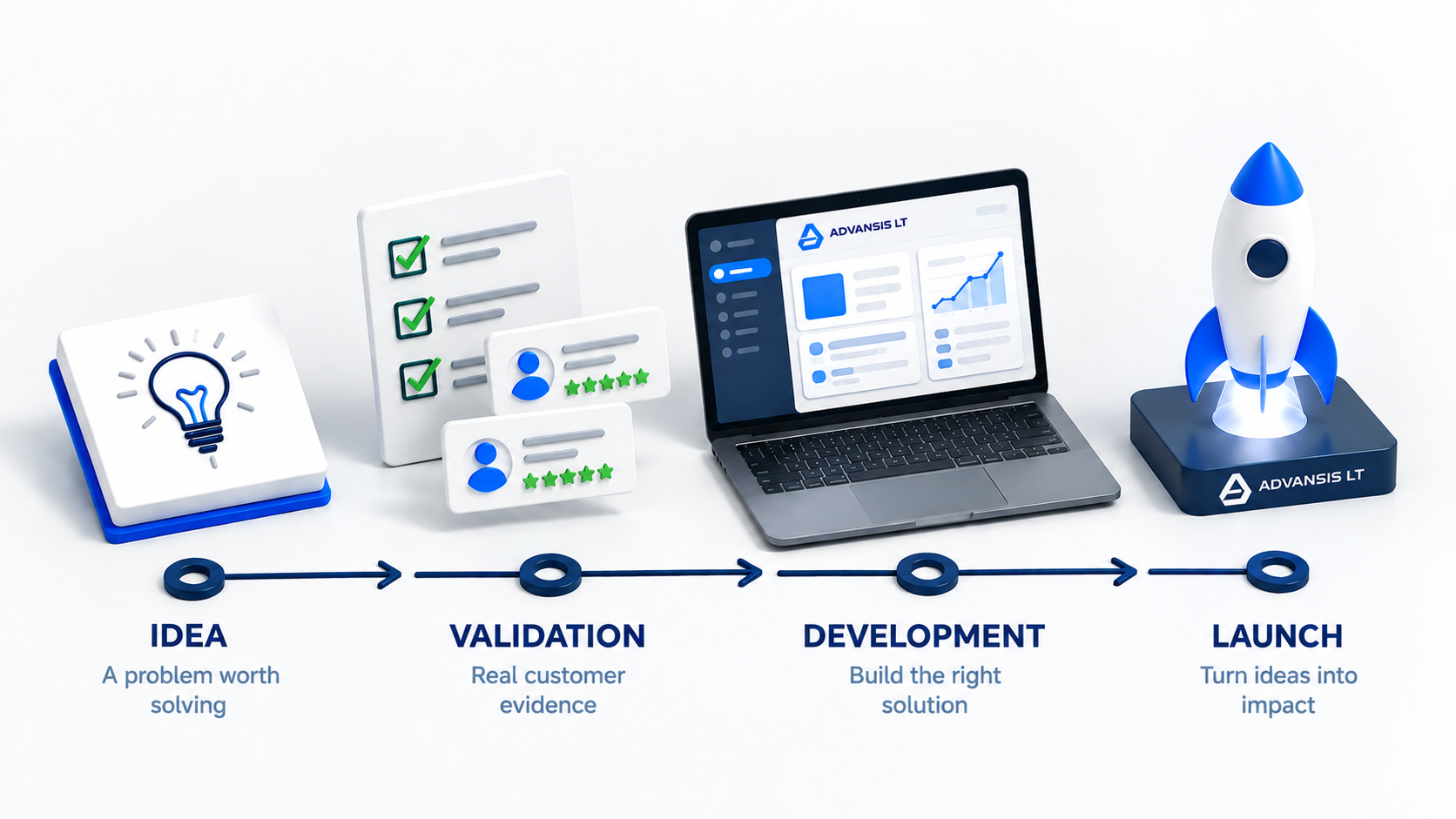
A startup idea is easy to create. The harder question is whether that idea is worth months of development and thousands of euros.
In 2026, founders face a strange paradox. AI-assisted development and modern product tools make software faster and more affordable to build. But that also means it has never been easier to build the wrong product.
Startup validation is the process of gathering evidence before making a larger product investment. It helps you test whether a real problem exists, whether the right customers care about it and whether they are willing to take meaningful action.
What Does It Mean to Validate a Startup Idea?
Validation is not a single survey, a few encouraging conversations or a large number of social media likes. It is a gradual reduction of uncertainty through observable evidence.
WEAK EVIDENCE
WHAT PEOPLE SAY
- — Interviews
- — Surveys
- — Positive feedback
STRONGER EVIDENCE
WHAT PEOPLE DO
- — Click a CTA
- — Book a demo
- — Test a prototype
- — Join a pilot
STRONG EVIDENCE
WHAT PEOPLE COMMIT TO
- — Letter of intent
- — Deposit
- — Paid pilot
- — Purchase
The 4 Things You Need to Validate
01
Problem
Is the problem real, frequent and costly enough to deserve attention?
02
Customer
Can you identify a specific first customer who experiences that problem?
03
Solution
Does your proposed approach make the outcome meaningfully better?
04
Willingness to Pay
Will customers commit budget, time or reputation to solve it?
- Problem
- Customer
- Solution
- Willingness to Pay
Start With a Hypothesis, Not a Product
Before designing screens or choosing technology, express your idea as a testable hypothesis.
Now you have something testable.
Step 1: Define Your Ideal First Customer
A startup aimed at everyone is difficult to validate. Start with the narrowest customer group that experiences the problem intensely and can be reached directly.
Too broad
Small businesses that need better software.
Better
Owners of 5–25 person accounting firms who repeatedly chase clients for documents before monthly reporting deadlines.
Ask:
- Who experiences the problem most often?
- Who feels the cost most strongly?
- Who is actively trying to solve it today?
- Who can approve a purchase?
- Where can you reach these people?
Step 2: Investigate the Problem Before Pitching Your Solution
Problem interviews work best when they focus on real past behaviour rather than selling your idea.
Eight useful interview questions
- Tell me about the last time this problem happened.
- What triggered it?
- What did you do next?
- How do you solve it today?
- What is frustrating about the current approach?
- What does the problem cost in time, money or missed opportunity?
- Who else is involved in solving or approving it?
- What have you already tried or paid for?
Step 3: Look for Evidence of Pain
| Area | Weak signal | Stronger signal |
|---|---|---|
| Problem | That sounds annoying. | The same issue appears repeatedly in recent examples. |
| Current solution | No action has been taken. | The customer uses a workaround, spreadsheet or paid tool. |
| Cost | The impact is unclear. | The customer can describe lost time, money or opportunity. |
| Urgency | Maybe someday. | A deadline or operational consequence creates pressure. |
| Purchase intent | I would probably use it. | The buyer asks about price, security or implementation. |
| Commitment | Positive feedback. | A demo booking, pilot, deposit, LOI or payment. |
- Area
- Problem
- Weak signal
- That sounds annoying.
- Stronger signal
- The same issue appears repeatedly in recent examples.
- Area
- Current solution
- Weak signal
- No action has been taken.
- Stronger signal
- The customer uses a workaround, spreadsheet or paid tool.
- Area
- Cost
- Weak signal
- The impact is unclear.
- Stronger signal
- The customer can describe lost time, money or opportunity.
- Area
- Urgency
- Weak signal
- Maybe someday.
- Stronger signal
- A deadline or operational consequence creates pressure.
- Area
- Purchase intent
- Weak signal
- I would probably use it.
- Stronger signal
- The buyer asks about price, security or implementation.
- Area
- Commitment
- Weak signal
- Positive feedback.
- Stronger signal
- A demo booking, pilot, deposit, LOI or payment.
Validation should progress from cheap evidence toward expensive evidence.
- OPINION
- INTEREST
- ACTION
- COMMITMENT
- PAYMENT
Step 4: Test the Value Proposition
Once the problem is clear, test whether your proposed value is understandable and compelling. You do not need a complete product to do this.
- Landing Page
- Prototype
- Demo
- Waitlist
- Book a Demo
- Pilot Offer
- Pre-sale
A simple landing-page validation test
- Problem
- Solution
- How It Works
- Example Output
- Price
- CTA
Measure what visitors do, not only what they say. A clear call to action can reveal whether the value proposition creates enough interest for someone to take the next step.
Step 5: Test Willingness to Pay Earlier Than Feels Comfortable
Everyone loved the idea.
Pricing conversations reveal hidden objections and help distinguish polite interest from commercial intent. The goal is not to optimize the final price yet. It is to learn whether the problem has economic value.
- Booked Sales Meeting
- Pilot Request
- Pricing Discussion
- LOI
- Paid Pilot
- Subscription
Step 6: Build the Smallest Useful Test
A validation product should test the riskiest assumption with the least unnecessary complexity.
Future product
Automated AI document workflow platform
A complete future vision may include team analytics, many integrations, mobile applications, complex permissions and configurable automation.
Not necessarily needed yet
- — Analytics
- — Integrations
- — Mobile apps
- — Permissions
- — Customization
- — Automations
First validation product
One meaningful workflow
- Upload
- AI processes
- User reviews
Don't build the smallest product possible. Build the smallest product capable of giving you a meaningful answer.
You Can Sometimes Validate With a Working Prototype
Faster AI-assisted development changes which validation experiments are practical. In some cases, a focused working prototype can generate stronger evidence than static screens because customers can complete the real workflow.
AI should accelerate the validation loop — not eliminate it.
This distinction is reflected in research on writing code versus shipping code: producing code is only one part of delivering reliable software and customer value.
Harvard Business Review also describes how AI makes building easier while choosing what to build becomes harder — reinforcing why faster execution should be paired with stronger validation.
The Advansis Validation Loop
01
PROBLEM
Define the painful situation and the specific customer.
02
EVIDENCE
Collect examples of current behaviour, cost and urgency.
03
PROTOTYPE
Create the smallest useful experience that tests the assumption.
04
BEHAVIOUR
Observe what real customers do with it.
05
LEARN
Compare the evidence with the original hypothesis.
06
MVP ↺
Build only when the evidence supports the next investment.
When Is Your Startup Idea Validated Enough to Build an MVP?
There is no universal validation threshold. Look for several forms of evidence converging around the same problem and customer.
| Question | Evidence you want |
|---|---|
| Is the customer specific? | A reachable group with shared characteristics and buying context. |
| Is the problem real? | Repeated recent examples described without prompting. |
| Is the problem important? | Visible cost, urgency or operational consequence. |
| Does the solution make sense? | Customers understand the value and can use the test. |
| Will customers act? | Demo bookings, pilots, introductions, deposits or payment. |
| Can you learn from an MVP? | A focused workflow can test the remaining critical assumptions. |
- Question
- Is the customer specific?
- Evidence you want
- A reachable group with shared characteristics and buying context.
- Question
- Is the problem real?
- Evidence you want
- Repeated recent examples described without prompting.
- Question
- Is the problem important?
- Evidence you want
- Visible cost, urgency or operational consequence.
- Question
- Does the solution make sense?
- Evidence you want
- Customers understand the value and can use the test.
- Question
- Will customers act?
- Evidence you want
- Demo bookings, pilots, introductions, deposits or payment.
- Question
- Can you learn from an MVP?
- Evidence you want
- A focused workflow can test the remaining critical assumptions.
You don't need certainty. Startups never have certainty.
Validation Is Not Product-Market Fit
01
IDEA VALIDATION
Evidence that the problem and customer deserve further investigation.
02
SOLUTION VALIDATION
Evidence that the proposed approach creates meaningful value.
03
MVP
A working first product that tests key assumptions with real users.
04
EARLY TRACTION
Repeated usage, learning and early commercial signals.
05
PRODUCT-MARKET FIT
Strong retention and demand from a defined market.
06
SCALE
Repeatable acquisition, delivery and expansion.
The Sean Ellis 40% benchmark asks how users would feel if they could no longer use a product. That is a useful product-market-fit indicator. It is not how you validate an idea before you have built anything.
Tools such as the Strategyzer Test Card help teams state assumptions and decide what evidence would support them.
7 Startup Validation Mistakes to Avoid
01
Friends and family
Treating friendly encouragement as market evidence
People close to you want to be supportive. Interview people who match the real customer profile.
02
Hypothetical intent
Asking Would you use this?
Ask about past behaviour and request a meaningful next action instead.
03
Premature building
Building before understanding the problem
A polished solution cannot compensate for a weak problem hypothesis.
04
Audience
Targeting everyone
A narrow first customer makes patterns, channels and purchase context easier to see.
05
Vanity evidence
Treating signups as demand
A signup indicates interest. Stronger evidence requires effort, reputation, time or money.
06
Commercial evidence
Avoiding pricing conversations
Test willingness to pay before the full product makes the conversation emotionally difficult.
07
AI overbuild
Using AI speed to build too much
Faster delivery should create faster learning loops, not a larger unvalidated feature list.
A Simple Startup Validation Scorecard
Score each area from 0 to 2: 0 means assumption only, 1 means some evidence and 2 means repeated behavioural or commercial evidence.
| Area | 0 — Assumption | 1 — Some evidence | 2 — Stronger evidence |
|---|---|---|---|
| Customer | Broad or undefined | Specific segment described | Reachable first buyers identified |
| Problem | Founder assumption | Several interviews agree | Repeated recent behaviour shows pain |
| Existing behaviour | No action today | Occasional workaround | Active workaround or paid alternative |
| Solution | Untested concept | Prototype interest | Real test completed successfully |
| Commercial intent | Positive words | Pricing discussion or demo | LOI, pilot, deposit or payment |
| Usage evidence | None | One-off test | Repeated use or requested continuation |
- Area
- Customer
- 0 — Assumption
- Broad or undefined
- 1 — Some evidence
- Specific segment described
- 2 — Stronger evidence
- Reachable first buyers identified
- Area
- Problem
- 0 — Assumption
- Founder assumption
- 1 — Some evidence
- Several interviews agree
- 2 — Stronger evidence
- Repeated recent behaviour shows pain
- Area
- Existing behaviour
- 0 — Assumption
- No action today
- 1 — Some evidence
- Occasional workaround
- 2 — Stronger evidence
- Active workaround or paid alternative
- Area
- Solution
- 0 — Assumption
- Untested concept
- 1 — Some evidence
- Prototype interest
- 2 — Stronger evidence
- Real test completed successfully
- Area
- Commercial intent
- 0 — Assumption
- Positive words
- 1 — Some evidence
- Pricing discussion or demo
- 2 — Stronger evidence
- LOI, pilot, deposit or payment
- Area
- Usage evidence
- 0 — Assumption
- None
- 1 — Some evidence
- One-off test
- 2 — Stronger evidence
- Repeated use or requested continuation
0–4
ASSUMPTION STAGE
Important claims still depend mainly on founder belief. Continue interviews and cheap tests.
5–8
EVIDENCE EMERGING
Promising signals exist, but the weakest categories need focused experiments.
9–12
READY FOR MVP EXPERIMENT
The evidence may justify a focused MVP designed to test remaining risks.
This score is not a scientific probability of startup success. It is a practical framework for identifying where your evidence is still weak.
Have an Idea but Not Sure If It's Ready for Development?
We can help you turn assumptions into a focused product scope and identify the fastest way to test your core idea.
Or use the MVP Cost Estimator to see how scope choices can affect effort, investment and timeline.
AI-assisted development can make experiments and prototypes faster. It does not guarantee that customers need the result, that the workflow is correct or that a buyer will commit.
Before asking
How quickly can we build it?
Ask
What evidence would convince us that we should build it?
Design the cheapest experiment capable of producing that evidence.
When the evidence becomes strong enough: Build the MVP. Put it in front of real users. Learn again.
Frequently asked questions
How many customer interviews are enough to validate a startup idea?+
There is no fixed number. Start with enough interviews to identify repeated patterns within a specific customer segment. Ten focused conversations can be more useful than one hundred broad surveys, but interviews alone are not enough. Progress toward behavioural and commercial evidence.
Can I validate a startup idea without building anything?+
Yes. Problem interviews, competitor research, landing pages, manual services, demos, letters of intent and pre-sales can test major assumptions before software development. Build only when a working interaction is the cheapest credible way to answer the next question.
Does a waitlist validate a startup idea?+
A waitlist indicates interest, especially when the audience and message are specific. It does not prove willingness to pay or sustained usage. Treat it as one signal and follow it with demos, pilots, deposits or another meaningful commitment.
Should I ask customers how much they would pay?+
You can discuss price, but hypothetical answers are weak evidence. Present a realistic offer and observe whether customers book a sales conversation, approve a pilot, sign a letter of intent, place a deposit or pay.
Should validation happen before or after building an MVP?+
Both. Validate the problem, customer and basic commercial logic before significant development. Then use the MVP to validate real usage, retention and the riskiest remaining assumptions.
Does an idea still need validation if competitors already exist?+
Yes. Competitors can confirm that a category and budget exist, but not that your target customer prefers your approach. Validate the specific segment, problem, differentiation, distribution and reason to switch.
When should I start building the MVP?+
Start when evidence from a specific customer group, repeated problem behaviour, solution tests and meaningful commitment is strong enough that a focused working product is the most efficient next experiment. You need evidence convergence, not certainty.
ADVANSIS LT
From Idea to Working MVP
A startup doesn't need more features to become real. It needs better evidence. Advansis LT helps founders turn validated ideas into focused scopes, thoughtful UX/UI and working MVPs.
Related Articles
MVP Development
How Much Does It Cost to Build an MVP in 2026?
A practical guide to MVP pricing, AI-assisted development, scope, timelines and the decisions that determine what you actually need to build.
9 min readMVP Development
What Features Should an MVP Have?
How to identify the core workflow, prioritize features and avoid overbuilding your first product.
10 min read